
When somebody says “we run on Salesforce,” they could mean any of more than a dozen products. Four of them cover what most businesses actually need from a CRM: Sales Cloud, Service Cloud, Marketing Cloud, and Commerce Cloud.
Here’s what each one does, who it’s for, and where the friction usually shows up when you have more than one.
Sales Cloud
Salesforce was the first company to bring CRM to the cloud, and Sales Cloud is the original product. It is where customer and prospect relationships live, where the pipeline is tracked, and where the daily rhythm of a sales team plays out.
The headline features are familiar to anyone who has run a sales team: leads, accounts, contacts, opportunities, forecasts, dashboards, activity tracking. The thing Sales Cloud does well, that most home-grown stacks fail at, is the boring middle. Pipeline at multiple stages with consistent definitions. Forecasts that roll up cleanly across regions and product lines. Handoffs from SDR to AE to CSM that don’t lose context.
The collaboration angle gets undersold. When sales, marketing, and account management see the same record at the same time, deals close faster and post-sale handoffs stop going wrong. That’s not a slogan. It’s what teams typically notice in the first quarter after moving from spreadsheets to Sales Cloud and using it properly.
Service Cloud
Service Cloud is the customer-service counterpart to Sales Cloud. It exists to solve two universal problems: agents getting overloaded, and response times getting slow.
The way Service Cloud solves them is with a unified customer view per case, plus automation of the predictable bits: email replies, status updates, task delegation, escalations. Agents work across channels (phone, email, web chat, social media) with the same context follow them everywhere. Service Cloud also enables AI-powered self-service: knowledge articles, chatbots, FAQs that pull from real product data so customers solve their own problems before they need a human.
When implemented well, the felt difference is “they actually know who I am and what’s going on with my case.” When implemented badly, it’s another ticketing system with worse search. The gap between the two is mostly governance: knowledge structure, case routing, escalation policy, and whether the platform is treated as a product or a checkbox.
Marketing Cloud
Marketing Cloud is for connecting with customers across the channels marketing operates in: online advertising, email, social media, mobile, push.
What makes Marketing Cloud worth its price tag, when it’s worth it, is the personalisation engine. The same customer profile that the sales team uses, the same one the service team sees, drives audience segmentation in marketing. You build journeys (the Salesforce term for multi-step automated sequences) that respond to behaviour in real time. You get a 360-degree view of each individual rather than the partial view a standalone email tool would have.
A note from experience: Marketing Cloud is the cloud where the gap between the demo and the production reality tends to be widest. The product is genuinely powerful, but extracting value requires data hygiene, channel strategy, and an ops team that knows what it’s doing. We’ve seen Marketing Cloud licences sit unused for two years because the team underneath wasn’t ready. Worth knowing before you sign.
Commerce Cloud
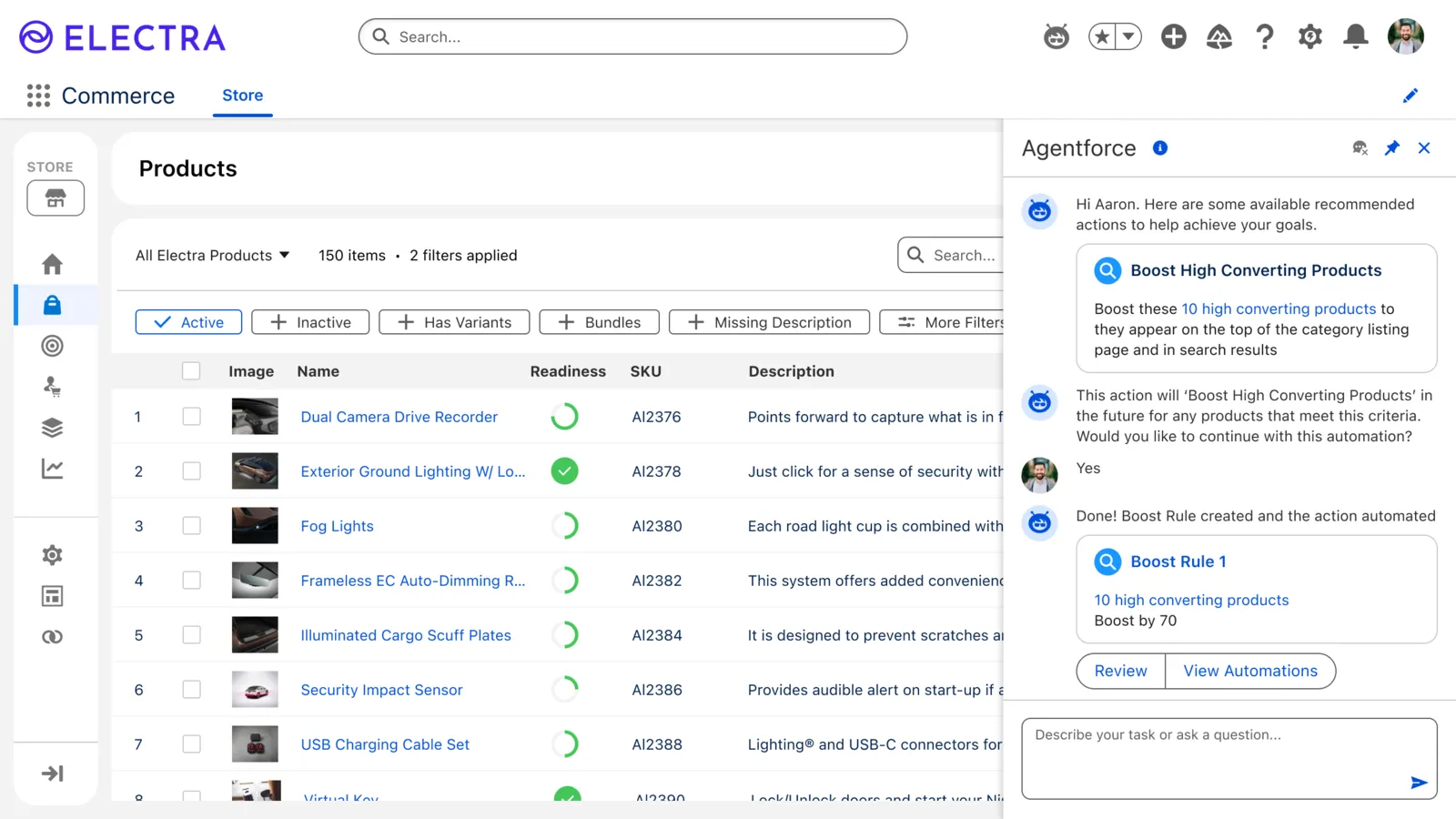
Commerce Cloud is the Salesforce platform for selling online. It handles orders, payments, and the personalised shopping experience across both B2B and B2C.
The differentiator is integration. Commerce Cloud lets you track failed transactions, unsuccessful searches, abandoned carts, all of it tied back to the same customer profile you’re using everywhere else. You sell the right products to the right customers because the data already exists.
Commerce Cloud is the cloud most likely to compete with a non-Salesforce alternative (Shopify, Magento, BigCommerce). The choice usually comes down to whether the integration with the rest of your Salesforce stack is worth the higher entry cost. For a B2B with complex pricing, contract terms, and CRM-driven customer relationships: usually yes. For a small B2C with a simple catalogue: often no.
Why one platform matters
The hard part isn’t picking which Cloud you need. It’s making them work together once you have more than one.
A team that runs Sales Cloud and Marketing Cloud separately, with two different customer profiles, has bought twice the licence cost for less than half the value. A team that runs Service Cloud without integrating to Sales Cloud creates the exact siloing CRM was supposed to fix. The integration story is the platform story; ignore it and you have a more expensive version of the spreadsheet sprawl you replaced.
Beyond these four, Salesforce also offers vertical-specific clouds like Health Cloud, Financial Services Cloud, and Manufacturing Cloud. Plus specialised products like Data Cloud and Agentforce. They share the same underlying platform. That’s why “we run on Salesforce” tends to drift towards “we run on Salesforce, and we keep adding to it.”
The drift is fine. What matters is that every addition is a deliberate choice, not a procurement reflex.