
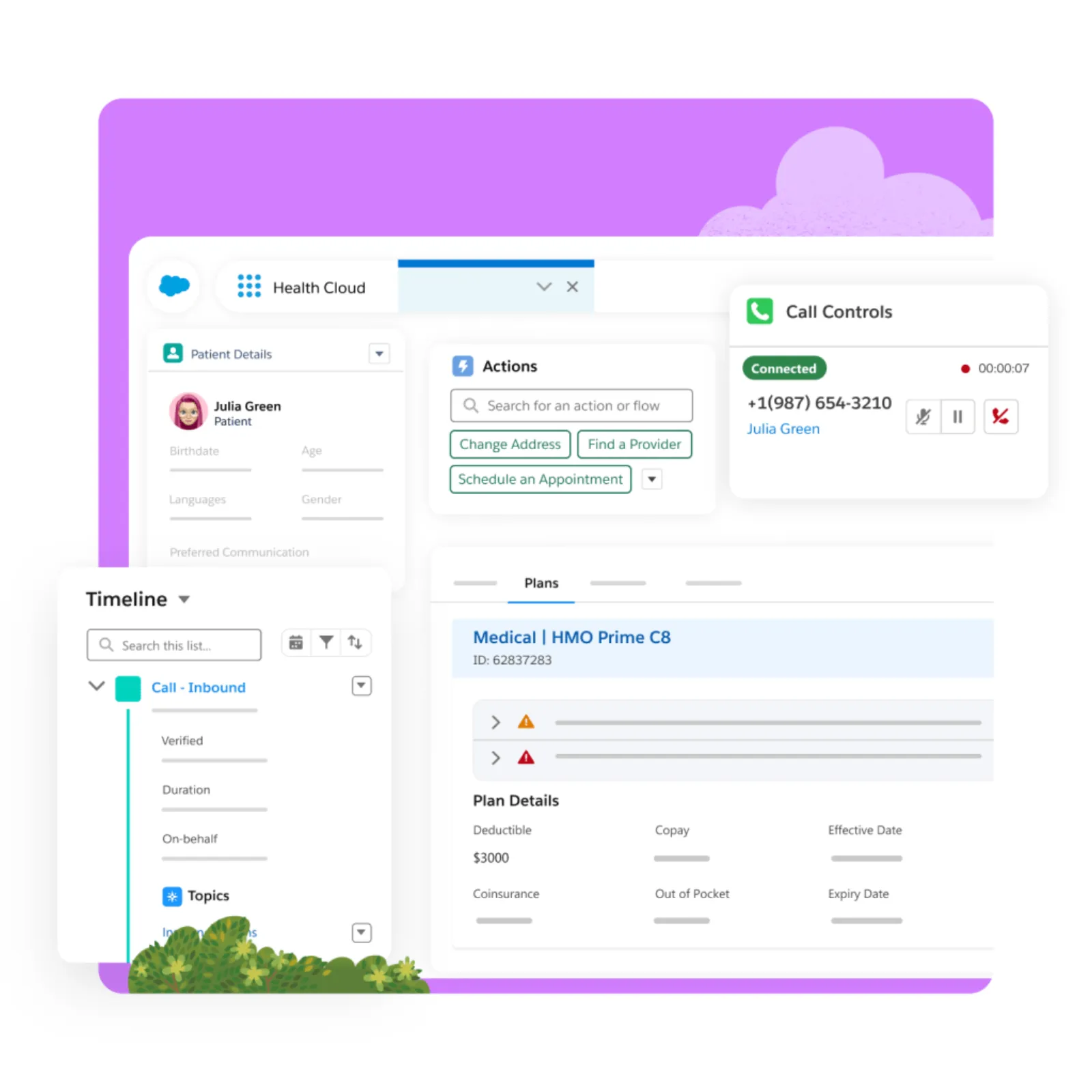
Salesforce Health Cloud is a dedicated CRM solution for healthcare and life-sciences organisations. Built on the Salesforce platform, it gives care teams a complete, 360-degree view of the patient, with features for unified health scoring, equitable access, and intelligent automation.
The shorter version: Health Cloud is Sales and Service Cloud plus a data model designed specifically for the way healthcare actually works.
What problem Health Cloud solves
Standard Salesforce treats relationships as company-to-customer or company-to-prospect. Healthcare doesn’t fit that shape. The “customer” might be a patient, but they’re also a member of a household, possibly a guardian for a minor, possibly under a care plan with multiple providers, possibly a beneficiary of a payer, and definitely the subject of regulated personal-health information.
You can model all of that on Sales and Service Cloud if you want to. Many organisations have. The trouble is you end up reinventing care plans, patient relationships, and consent management on top of a CRM that wasn’t designed for it. Three years in, the customisations have ossified, the upgrade path has narrowed, and bringing in a new admin requires a six-week handover just to explain how the schema deviates from standard.
Health Cloud meets the industry where it lives. Patient, Care Plan, Care Team, Healthcare Provider, household-aware relationships, all built into the platform from day one rather than bolted on by your last consulting partner.
How Health Cloud works
Health Cloud inherits the full Salesforce platform. Every feature of Sales Cloud and Service Cloud is available, with a layer of healthcare and life-sciences data structures sitting on top. EHR integrations, clinical-data exchange (FHIR), HIPAA-aware access controls, and the kinds of audit trails regulators expect.
The product is designed around five verticals:
- Provider (hospitals, clinics, care networks)
- Payer (insurance, benefits administration)
- Medtech (medical devices and equipment)
- Pharmaceutical
- Public health
Each vertical gets its own preconfigured objects, processes, and integration points. A hospital network’s Health Cloud setup does not look like an insurance carrier’s, even though they share the same platform underneath. That’s intentional. The work of fitting the same generic CRM to such different operational shapes is real, and it’s work Health Cloud has already done for you.
Why teams choose Health Cloud over plain Salesforce
The marketing copy will tell you Health Cloud is “scalable, secure, and trusted.” That’s true of any Salesforce product. The actual reasons we see teams choose Health Cloud are more specific.
The data model maps to clinical workflows out of the box. Care plans, care team membership, provider relationships, household structure, episode-of-care tracking, all are first-class objects. You don’t earn the right to use them by reverse-engineering custom objects.
Compliance becomes architecture, not afterthought. HIPAA-aligned controls, BAA-ready hosting, granular field-level encryption, and consent management are baked in. The org you stand up on day one is the kind of org auditors expect to see, not the kind your security team will spend a year hardening.
Industry-standard integrations are pre-built. EHR systems, clinical data formats (FHIR, HL7), payer adjudication, pharmacy networks. The integrations exist. You configure them rather than build them.
The upgrade path stays open. Because customisation lives within Health Cloud’s intended extensibility points, you can adopt new Salesforce features (Data Cloud, Agentforce) as they ship, instead of finding out your custom Patient object conflicts with the standard one Salesforce just introduced.
When Health Cloud is the right answer
Health Cloud is worth considering when at least one of the following is true: you handle protected health information at scale, your workflows involve care plans or care teams that span multiple providers, you need household-aware patient relationships, or you operate in one of the five verticals above and need preconfigured industry shape rather than building it on Sales and Service Cloud.
If you’re a small clinic with simple appointment management, Health Cloud is probably overkill. If you’re a multi-site provider network with payer integrations, care-plan automation, and a regulator who calls every quarter, it’s almost certainly the right starting point.
The platform comes with the patterns built in. The work, when you engage someone like us, is making them fit your specific operation, your existing systems, and the regulatory environment you actually live in.