
Salesforce is the world’s leading customer relationship management (CRM) software. That’s the textbook answer. It’s also a phrase that hides a lot.
“Salesforce” can mean a fifteen-person sales team running Sales Cloud and nothing else. It can also mean a Fortune 500 with multiple Salesforce orgs, Data Cloud, Agentforce, and a dedicated platform team holding it all together. Same technology underneath. Very different work to run it well.
This post answers the three questions almost everyone Googles the first time they meet the platform: what is it, where did it come from, and where is it actually used.
How Salesforce works
At its core, Salesforce is still a CRM, the system of record for every interaction your company has with customers and prospects. That’s how it started in 1999, and it’s still where the platform earns its keep.
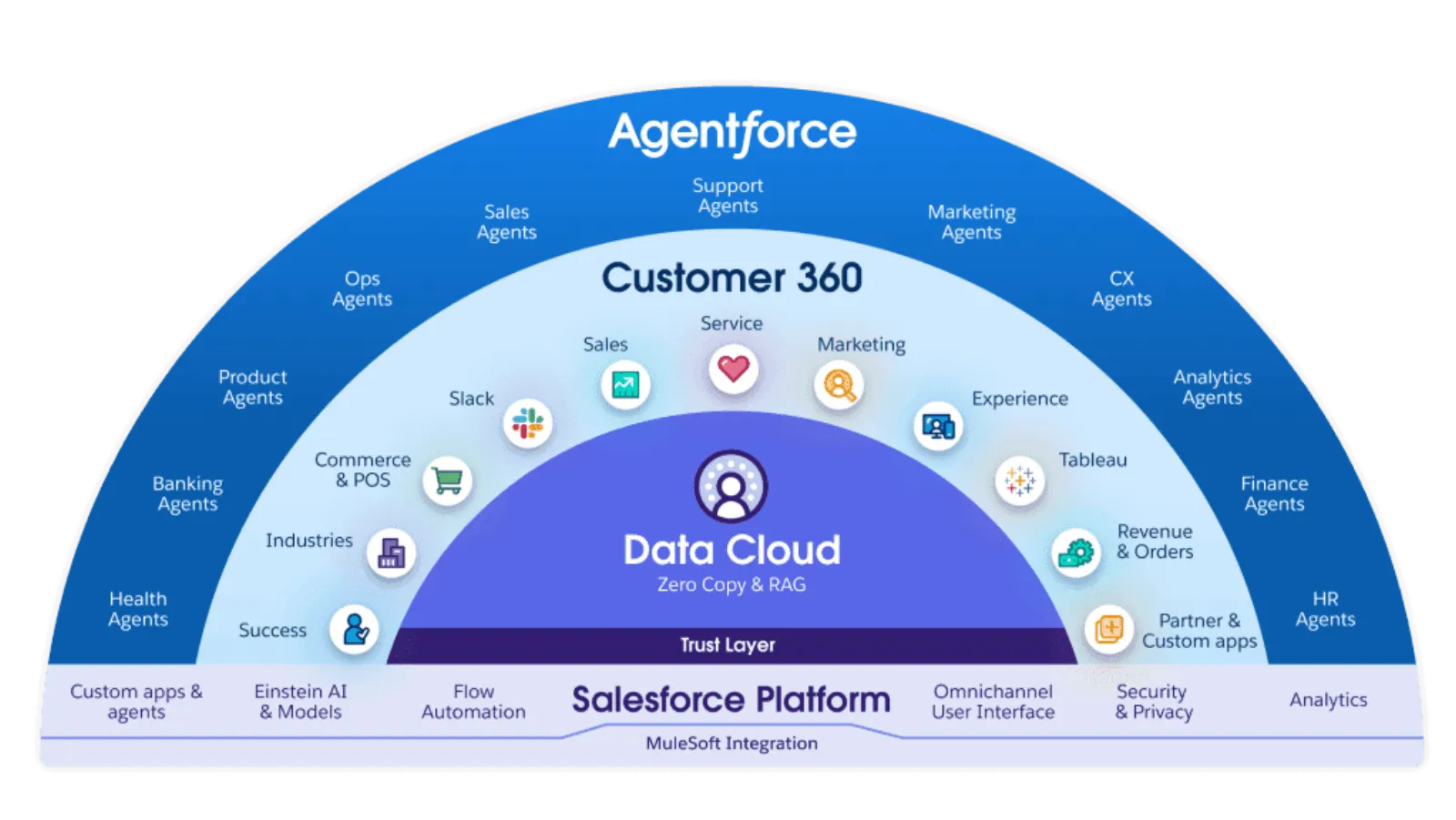
But “CRM” undersells what Salesforce has become. On top of that core, the platform now ships data tools, native AI, and apps for service, marketing, commerce, and IT. The thing that separates Salesforce from “we have a CRM and we have a marketing tool and we have a service tool, and they sort of share data when somebody exports a CSV” is that all of it sits on a single platform that talks to itself.
What you get out of that, in practice: one place where the sales journey lives, from first prospect to closed deal to renewal. And for the engineers building on top of it, a real platform with a metadata model, APIs, and an extensibility story that doesn’t rot every release.
How Salesforce started
In 1999, Marc Benioff, Parker Harris, Frank Dominguez, and Dave Moellenhoff started building the first version of Salesforce CRM in a one-bedroom apartment on San Francisco’s Telegraph Hill. The pitch was radical for the time: enterprise software that ran in the cloud, sold by subscription, with no on-premise installation. “No software” was the literal slogan, complete with a logo of the word inside a red circle with a slash through it.
The four of them worked to a discipline that has since become company lore: only build what’s important and necessary, and do it “fast, simple, and right the first time.”
More than two decades later, you can still feel that culture in the platform. Three releases a year, on schedule. An ecosystem that has grown to hundreds of thousands of developers, admins, consultants, and ISVs. A product portfolio that has expanded by acquisition and by build, but mostly without the sprawl that hits companies of similar age.
Where Salesforce is used
Today the portfolio covers sales, service, marketing, commerce, AI, data, and a long tail of industry-specific clouds. There is no single “Salesforce setup” that works for everyone, and that’s the point. The right configuration depends on what your business does and where it needs help.
Current Salesforce customers include FedEx, Uber Eats, Siemens, BP, and Make-A-Wish, alongside tens of thousands of smaller businesses you’ve never heard of. The platform is industry-agnostic by default, with vertical-specific clouds (Financial Services Cloud, Health Cloud, Manufacturing Cloud, others) for industries with specialised data shapes.
That breadth is also why Salesforce projects vary wildly in scope. “We’re implementing Salesforce” can mean a Sales Cloud setup for fifteen users, or a multi-org Data Cloud and Agentforce programme for tens of thousands. The technology stays the same. The discipline required to deliver it well does not.
In our work, we see the same pattern again and again: the difference between a Salesforce implementation that compounds value year on year and one that quietly becomes shelfware is rarely about the technology. It’s whether the people running it know what they’re doing, and whether the people building on it know when to push back.
If you want a deeper read on how the four major Clouds (Sales, Service, Marketing, Commerce) compare, the cloud portfolio post breaks each one down.